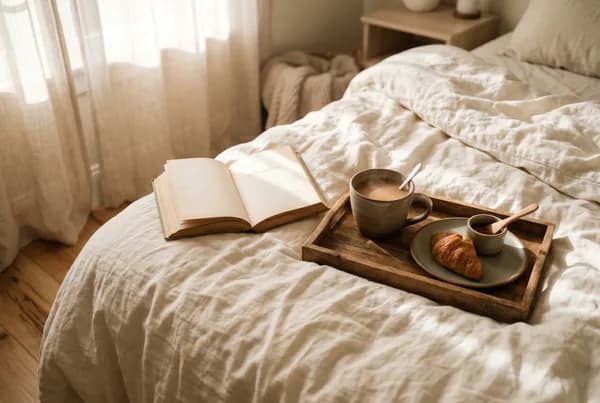
Your morning does not have to look like anyone else's, because a morning ritual that holds is the one that survives a bad night, not the one that photographs well. Ninety seconds that are genuinely yours will outlast an hour borrowed from someone else's circumstances.
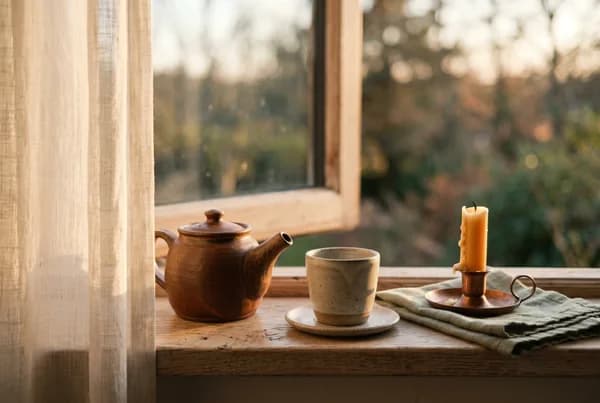
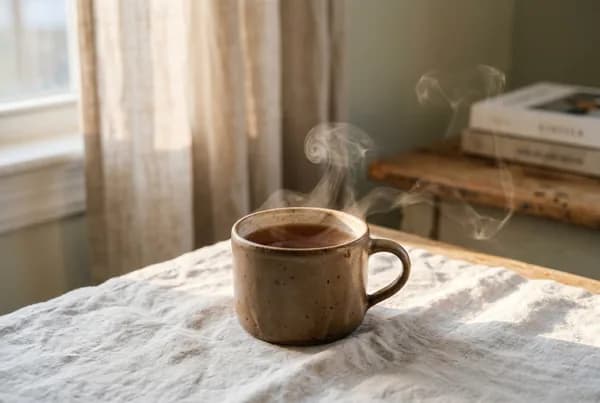
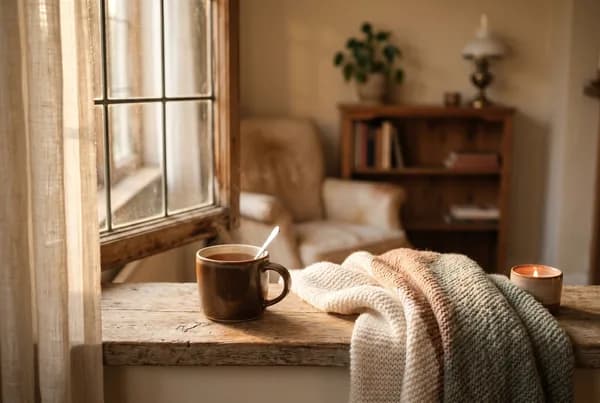
There's a kettle in my kitchen that takes about ninety seconds to boil, and for a long time that ninety seconds was the whole of my morning to myself. I didn't plan it that way. It was just the gap between waking and the rest of the day arriving, and I stood in it because there was nowhere else to go. I used to feel slightly ashamed of that gap. It looked so unimpressive next to the mornings I'd see on my phone - the made bed, the lemon water, the journal open to a clean page, the light coming in like it had been ordered specially.
I believed, for a while, that those mornings were the real ones and mine was the deficient version. That if I just got up earlier, bought the right notebook, downloaded the right app, my morning would finally look like the picture.
It never did.
What I missed for a long time is something I think a lot of us miss. The morning you see online is a photograph. It is one room, in one house, with one particular set of circumstances - no one needing to be anywhere, no broken sleep, no small body climbing into the bed at five. It is someone else's life, staged under someone else's conditions, and it was never going to fit mine no matter how early I set the alarm. A morning ritual that actually holds isn't the one in the photo. It's the one that survives a bad night.
I should say what my mornings actually contained back then. I have a child who, for about two years, treated four-forty as a reasonable hour to begin the day. I had a body that did not wake gently - it woke with the lights already on, the to-do list already running. The idea of an hour-long routine, of stretching and writing and sitting in dawn light, was not aspirational to me. It was a small cruelty. Every time I tried it, I failed by about six minutes in, and then I carried the failure around all day like a stone in my pocket. The routine wasn't making me calmer. It was just one more thing I wasn't doing well enough.
The thing I eventually understood is that the routine had nothing to do with me. It was built for a different person, in a different morning. I had been trying to wear someone else's coat and wondering why it pulled across the shoulders.
So I stopped. Not all at once, and not nobly. I just got tired of starting each day by losing.
What I found, when I let the borrowed version fall away, was much smaller and much stranger and entirely mine. It was the kettle. Those ninety seconds while the water came up to the boil, when I would put both hands flat on the bench, feel the cold of the stone, and breathe out once, slowly, all the way down. That was it. That was the whole practice. Not ten minutes of curated stillness - sometimes barely one. Some mornings the child was already calling out and I'd do it with one ear turned to the hallway. Some mornings I forgot until I was halfway through the day and did it standing at the sink at two in the afternoon instead, which I decided was allowed.
It was odd. It would photograph terribly. There is nothing to put on a phone in a woman leaning on a kitchen bench with her eyes half-closed, waiting for water. But it was true, and it held, and it held precisely because it asked almost nothing of me. It fit the morning I actually had instead of the one I was supposed to perform.
I think that's the part the elaborate routines quietly take from us. They suggest that if your morning is small, your inner life must be small too. That a real practice has to be earned with discipline and an early alarm, and if you can't manage the full production, you've somehow failed at being a calm person. But stillness doesn't check the clock. It doesn't care whether you sat cross-legged or stood at the bench with porridge to make. It only asks that you arrive, for a breath, before the day takes you.
A bad night doesn't disqualify you from it. An early child doesn't. A slow body, a noisy house, a morning that came at you sideways - none of it disqualifies you. If anything, those are the mornings that need the breath most, and they are exactly the mornings the photographed routine cannot survive.
So here is the only thing I'd offer, and offer gently. Find the gap that already exists in your morning - the kettle, the shower running warm, the minute the car takes to demist, the pause before you open the door to wherever you're going. You don't have to build anything. The gap is already there. Just stand in it on purpose, once, and breathe out all the way to the bottom. Let that be the whole of it. Let it be one minute, or thirty seconds, or whatever the morning actually leaves you. Let it be imperfect and unphotographed and entirely your own shape.
It will not look like anyone else's. That's not the flaw in it. That's the proof it's real.
I still lean on that bench most mornings, hands flat, waiting for the water. The child sleeps later now, the to-do list is quieter, but the ninety seconds have stayed, because they were never borrowed from anyone. They were mine the whole time. I just had to stop measuring them against a morning that was never going to be.