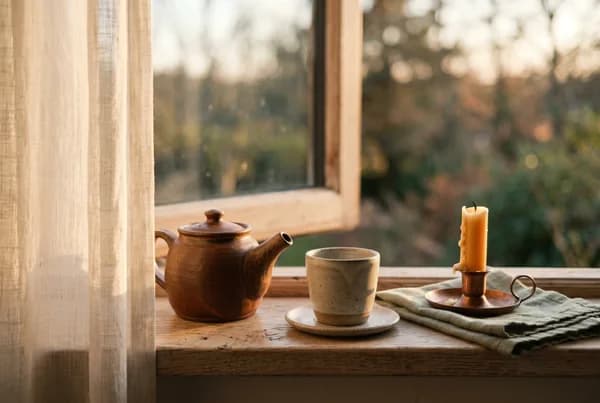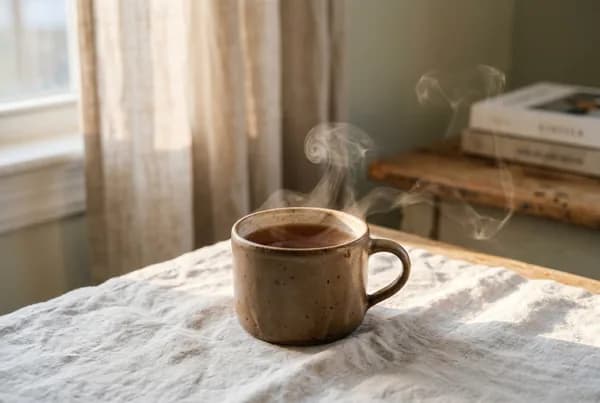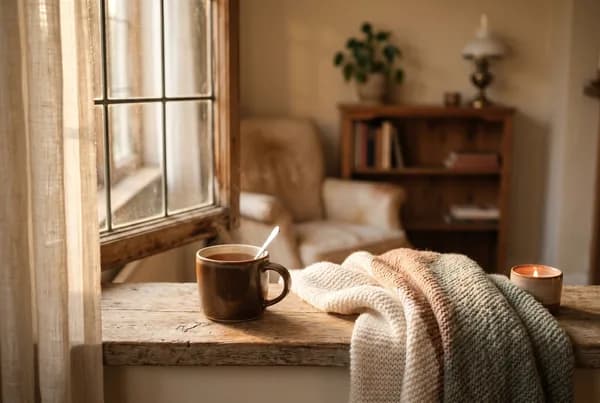
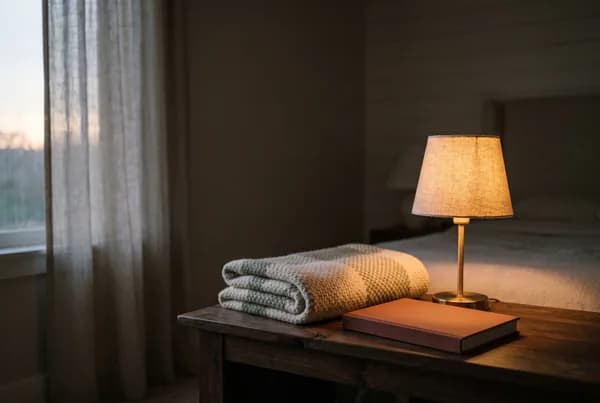
An evening ritual is a small, repeated set of actions that tells your body the day is ending. Dim the lights. Set the phone down. Move slower. It is not a strict routine to perfect - it is a soft signal, given the same way each night, until the body learns to trust it.
I came to mine the long way. For years my evenings just stopped, abruptly, whenever I ran out of hours.
Then I would lie down and wonder why I was still wide awake.
The body had not been told. I had gone straight from the bright, fast day to the dark, still bed, and asked it to switch in a second.
Why a ritual helps you sleep
The body reads cues, not clocks. A ritual gives it cues it can recognise.
When the same gentle things happen each night, your system starts to anticipate rest before you reach the pillow. The dimming light, the cooler room, the slower hands. These become a kind of language.
I noticed this first with a lamp. I started turning off the overhead light an hour before bed and using one low lamp instead. Nothing else changed at first. But the room softened, and so did I.
It was not the lamp. It was the repetition. Same act, same hour, every night, until my body began to lean toward sleep on its own.
You are not forcing rest. You are inviting it, with signs it has come to know.
There is something tender in that, I think. The body is always listening, always trying to read what comes next. For years I sent it mixed signals - bright then dark, loud then silent - and then blamed it for not knowing how to settle.
When I started speaking to it kindly, in the same few words each night, it began to answer. Not at once. But slowly, the way trust always builds.
A simple evening ritual to try
Begin one hour before sleep. Lower the lights. Put the screens to bed before you go.
The screens are the hard part. I know. Mine used to be the last thing I touched and the reason I could not settle. So I gave the phone its own place to rest, across the room, and let the last hour be quieter than the rest.
In that hour I do small, slow things. I tidy one surface. I make a warm drink. I read a few pages of something undemanding.
None of it is impressive. That is the point. The ritual is not meant to be productive. It is meant to be the same.
If your mind is still racing, let your hands lead. Wash the cup. Fold the blanket. The body grows calm through doing, and the mind tends to follow where the hands go.
I keep mine short on busy nights - three small things instead of seven. A shortened ritual still works. A skipped one teaches the body nothing.
What matters is the sameness, not the length. The body is not counting your steps. It is only listening for the pattern it has learned to trust.
What to do when the day will not let go
If the day keeps replaying, name it once, gently, then set it down. You are not solving it tonight. You are only closing it.
Some evenings the worry follows me in. I used to fight it, which only kept it close. Now I let it have a moment, and then I let it pass.
I find it helps to write one line before bed. Not a list. One sentence about the day, true and brief. It is a way of telling the day I have heard it, so it does not need to keep speaking.
Then I breathe out slowly, longer than I breathe in, a few times over. The long exhale is the oldest signal for safety the body knows. It does not need to be taught.
I find the breath is the one thing I always have with me. No lamp required, no quiet room. On the nights when nothing else is possible, there is still the slow breath out, and it is enough to begin the softening.
The day will still be there in the morning. It always is. But it does not have to come to bed with you.
Letting the ritual stay soft
A ritual works because it is kind, not because it is strict. The moment it becomes another task to fail at, it stops giving rest.
For a long time I held mine too tightly. If I missed a step I felt I had ruined it. But rest does not come from precision. It comes from gentleness, repeated.
So I let mine be loose. Some nights it is the lamp and a long breath and nothing more. That is still the ritual. The shape can change. The kindness should not.
If you would like a few quiet practices to draw the day to a close, I keep some in Deep Rest - small ways to soften the hour before sleep.
There is a quieter way to end a day. Not by collapsing into the dark, but by walking toward it slowly, with the same few gentle steps, until your body knows the way home.
Rest is waiting. You only have to slow down enough to meet it.