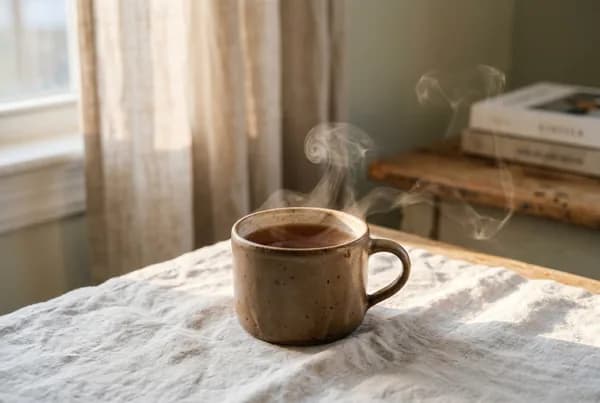
A routine is a sequence you repeat to get something done. A ritual is the same sequence held with attention, so the doing carries meaning. The actions can look identical. What changes is whether you are present for them, or only passing through.
I noticed the difference one ordinary morning, kettle in hand.
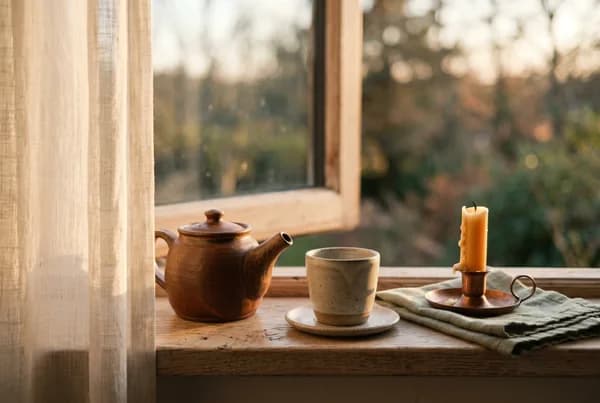
I had made tea ten thousand times. That day I happened to watch the water darken, and something in me settled before the cup was even full. Nothing in the act had changed. I had.
What separates a ritual from a routine
A ritual is a routine you have chosen to meet rather than merely complete. The structure is the same - the steps, the order, the timing. The difference lives in your attention. A routine asks for your hands. A ritual asks for you.
I used to think the answer was to add more. A better cushion, a longer practice, a special hour. None of that was the thing.
The thing was smaller and quieter. It was the willingness to be inside the minute I was already in.
You can test this without changing your day at all. Pick something you already do - the first sip, locking the door, the walk to the car. Do it once with full attention. Notice the weight of the keys. Feel the warmth of the mug. The act stays ordinary. Your relationship to it does not.
That is the whole shift. Not more doing. More presence inside the doing you already have.
I have tried it now with the smallest things. Hanging out the washing. Wiping down the bench at the end of the day. The mind wants to call these chores and rush them, so it can get to the part it has decided matters more. But there is no part that matters more, not really. There is only this part, and then the next.
When I let the small act be the whole of my attention, it stops feeling like an obstacle between me and my life. It becomes the life.
Why the line between them matters
The line matters because a routine can run while you are absent, and a ritual cannot. One keeps the day moving. The other lets you actually be in it. When too much of life is routine, you arrive at evening having done everything and felt almost none of it.
I think this is why so many full days feel strangely empty.
We move through them efficiently. We tick the boxes. And then we wonder where the hours went, as if they were stolen, when really we simply were not there for them.
A ritual returns you to the hour. It does not slow the clock. It changes who is present while the clock runs.
There is a quieter way to hold a day, and it does not require rearranging the day at all. It asks only that you stop outsourcing your attention to the next thing.
I think the cost of pure routine is subtle, which is why it goes unpaid for so long. Nothing dramatic breaks. You function. You are even productive. But a low hum of absence settles over everything, and you start to suspect that life is happening somewhere just out of reach.
It is not out of reach. It is in the very moment you keep skipping past on your way to the next one.
How to let a routine become a ritual
To turn a routine into a ritual, pause for one breath before you begin, then stay with the action through to its end. The pause is a small door. It tells the part of you that is always racing ahead that this moment is allowed to count.
I keep mine plain. Before I make tea, I let the kettle fill and I do nothing else. No phone, no list, no rehearsing the day. Just water, and the small sound of it rising.
Some mornings my mind still wanders. That is fine. The practice is not perfect attention. It is returning, gently, when you notice you have left.
If you want a single place to begin, begin with something you cannot skip - a meal, a threshold, the moment you wake. These already happen. You are only adding yourself to them.
You can read more about building this kind of attention in my notes on ritual. And if you would like a gentle daily structure to lean on, Daily High Vibe holds a small rhythm you can meet each morning without effort.
What stays when the striving stops
When you stop trying to make a moment special, it becomes available to be exactly what it is. A ritual does not decorate an ordinary act. It lets you stop overlooking it. The plainness was never the problem. The looking-past was.
I have stopped chasing the perfect morning.
The tea is the same tea. The light through the window is the same light. What has changed is that I am here for it, and being here turns out to be enough.
Nothing needed adding. Something only needed to be noticed.
The kettle clicks off. I pour. For a moment there is only the warmth in my hands and the quiet of the room.
I stay there a breath longer than I need to. That breath is the whole practice. Everything else is just tea.