A weekly ritual is a small, repeated practice that marks the end of one week and the start of rest - a way of telling yourself the work is set down now. It needn't be elaborate. A few quiet minutes, the same way each week, is enough to give a week its proper ending.
For a long time my weeks didn't end. They just stopped.
Friday would dissolve into Saturday with no seam between them, the open tabs of one week still glowing faintly behind the next. I carried Thursday's worry into Sunday without ever deciding to. Nothing was ever closed. It was only paused.
I think a lot of us live this way - in one long unbroken stretch, no edges, no rest that feels like rest.
Why does a week need closing at all?
A week needs closing because the mind doesn't naturally let go of unfinished things - it keeps them quietly open, waiting. A small ritual gives those open loops somewhere to land, so the time that follows can actually feel like rest rather than a pause between efforts.
I noticed this first in my Sundays.
They were meant to be restful and instead they hummed with a low static. Things half-thought, decisions half-made, the residue of five days I had never actually put down. I was resting on top of a pile of open work and wondering why it didn't feel like enough.
The closing is what changes that.
It is not about finishing everything - most weeks nothing is truly finished. It is about consciously setting the week aside, the way you might close a book with your thumb still in it. The story isn't over. But you've chosen to stop reading for now, and that choice is the whole thing.
When I started ending my weeks on purpose, the rest that followed had weight. It had earned its place.
What makes a ritual different from a routine?
A ritual differs from a routine in attention rather than action - a routine is something you do, while a ritual is something you mean. The same cup of tea can be either; what makes it a ritual is the small turning-toward, the brief decision to be present for it.
This distinction took me a while to feel.
I had plenty of routines. I did the same things at the same times and felt nothing in particular about any of them. They moved me through the week without ever touching me.
A ritual is slower in a way that has nothing to do with clock time.
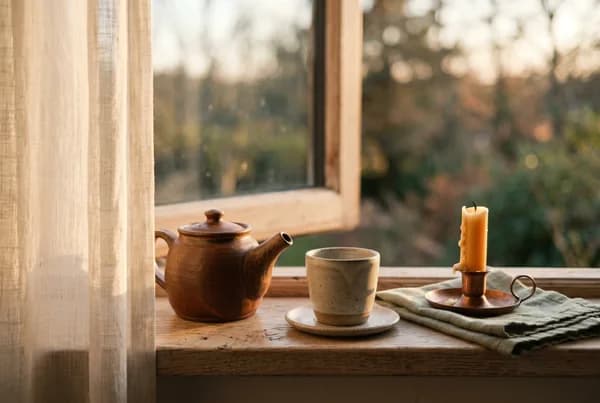
When I light a candle on a Friday evening, it takes the same ten seconds it always would. But I am there for those ten seconds. I am letting the small flare of the match mean something - this is the edge, the week ends here. The meaning is not in the candle. It is in my willingness to notice it.
That willingness is the only ingredient a ritual really needs. Everything else is decoration.
What does a gentle weekly ritual look like?
A gentle weekly ritual looks like a few unhurried minutes, repeated the same way each week, where you mark the close of one stretch of time before resting. It might be tea by a window, a short walk, or simply sitting still - anything you can return to without effort.
Mine is plain enough that I almost feel shy describing it.
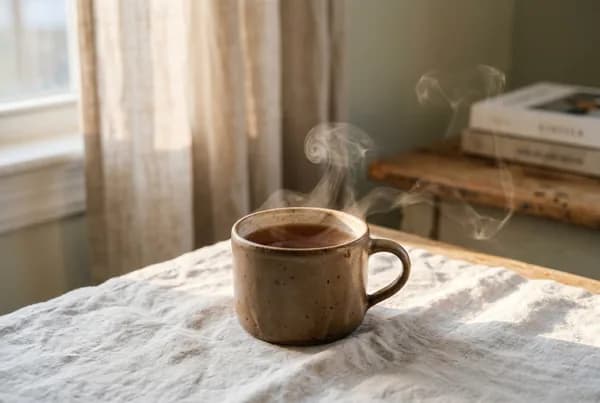
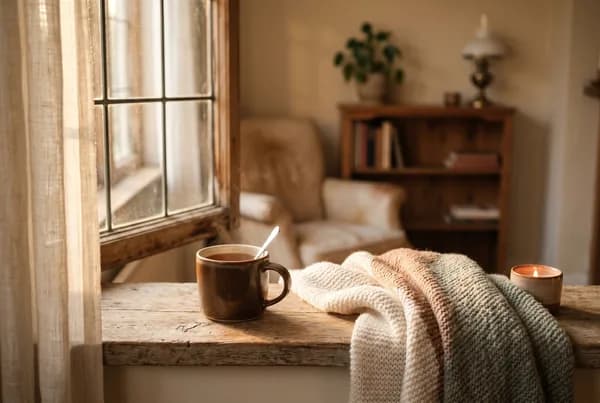
On Friday evening, when the day has gone soft, I make a pot of tea and sit by the window where the last of the light comes in. I let myself think back over the week - not to grade it, only to acknowledge it. The hard parts. The small mercies. The things I never got to.
Then I say, quietly, that's the week. And I mean it as a kind of release.
That's all. There is no list, no review, no resolution for the days ahead. Those belong to a different self, the Monday one, and she can have them when she arrives. For now there is only the tea and the fading light and the sense of something gently closed.
If you would like more of this kind of thing, I keep it gathered under ritual, and a soft weekly prompt for it lives in Daily High Vibe if you'd ever like a small hand with the rhythm.
How do I keep a ritual from becoming a chore?
You keep a ritual from becoming a chore by holding it loosely - letting it move, shrink, or be missed without guilt. The moment it feels like an obligation it has stopped being a ritual, and the kindest response is to soften it rather than enforce it.
I have made this mistake too.
I once turned my Friday tea into a rule, and within a month it had the dull weight of homework. I had taken a small kindness and made it a demand, and of course it stopped giving anything back.
So now I hold it open-handed.
Some weeks the ritual is the full pot of tea by the window. Some weeks it is three breaths at the kitchen sink because that is all the week left me. Both count. The closing is not measured by its length but by the turning-toward, and that turning takes only a moment.
A week deserves a gentle ending. Not a perfect one - a gentle one. There is a quieter way to reach the weekend, and it begins with letting the old week go before you ask the new one to begin.