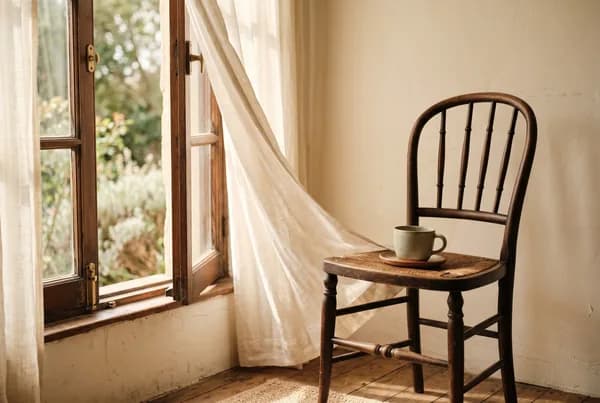
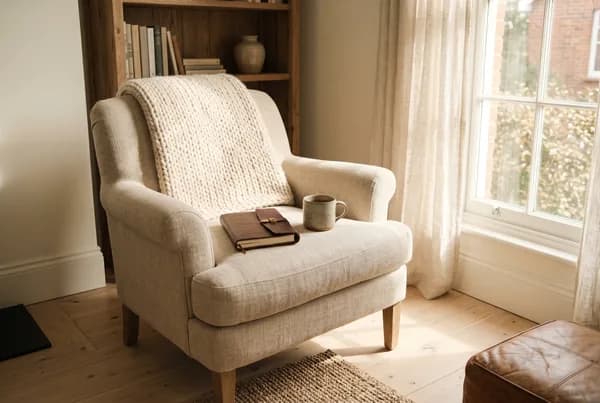
Some mornings the light comes through the east window at an angle that only lasts a few minutes, and I have learned to stop whatever I am doing and let it land on the floorboards. It moves. You can almost watch it go. I used to think the point of noticing something was to do something with it - file it, solve it, turn it into a plan. Now I just watch the light cross the room and then leave, and I have stopped asking it to mean anything.
There are some things in a life that work the same way.
For a long time I treated everything as a problem. A problem has a shape you can get your hands around. It has a beginning and a middle and, if you are clever or stubborn enough, an end. You solve it and it closes behind you and you never have to think about it again. I was good at this. It was, more or less, what I was paid to do for years - take something tangled and hand it back tidy. So when the bigger things arrived, the ones that did not have edges, I reached for the same tools. I tried to solve them. I made lists. I read the books. I waited for the click of a thing falling into place.
And nothing clicked. Because they were never problems. They were questions.
I have come to think a problem and a real question are different kinds of creatures entirely. A problem wants to be answered and then to disappear. A real question does not want answering at all. It wants to be lived alongside. It changes you not by being resolved but by being held - slowly, over years, the way water changes a stone without ever announcing it. If you force an answer, you usually get a small one, and the question quietly waits for you on the other side of it, patient, unbothered, still there.
The one I carried for a long time was about my mother. Not a tidy psychological matter, nothing you could put a name to. Just a low, persistent ache of why were we never able to reach each other. I spent a good part of my thirties trying to answer it. I built theories. I assigned blame, first to her, then, more fashionably, to myself. I rehearsed conversations I would never have. I treated it like a knot I could pick loose if I only found the right end of the thread, and every answer I arrived at felt true for about a week and then thinned out into something that did not fit.
What I did not understand was that I kept trying to close a question that was asking to stay open.
The shift, when it came, was not dramatic. It was during those quiet ten minutes I had started keeping in the mornings, when I was not trying to fix anything because there was nothing to fix in that small stretch of time. The question surfaced, the way it always did. And instead of reaching for it - instead of picking up the rope and starting again - I just let it sit there with me. I did not answer it. I did not even try. I let it be a question in the room, the way you let a guest sit quietly without needing to entertain them.
Something eased. Not the question. Me.
I started to keep it company rather than interrogate it. I would notice it the way I notice the morning light - ah, there it is - and let it pass through without demanding it hand over its meaning first. And here is the strange part, the part I did not expect. By stopping the search for an answer, I began to understand my mother more, not less. Not in conclusions. In small recognitions. A way she had of going quiet that I caught myself doing. A softness underneath the distance that I could only see once I had put down the case I was building. The question did not resolve. It deepened. It turned, slowly, from an ache into something closer to tenderness, and it did that work entirely on its own, while I was busy not solving it.
I think we are taught, gently and everywhere, that an unanswered question is a kind of failure. That a mature person has things worked out. So we rush. We grab the first answer that holds still long enough, and we call that peace, when really it is just the noise of the question turned down. But some questions are not loose ends to be tidied. They are companions. They are how a life keeps asking us to stay awake to it.
So this is what I would offer you, if you have a question like that - the one you keep trying to put to bed, the one that will not stay answered no matter how many times you settle it. Try, just once, to stop solving it. Sit somewhere ordinary and let it be in the room with you, the way you would sit beside someone you love without needing to talk. Do not look for the answer. Look at the question instead, kindly, the way you would look at a face. See what it is actually asking, underneath the asking.
You may find it has something to give you that an answer never could.
Mine is still with me. I do not expect it to leave now, and I have stopped wanting it to. Some mornings it sits beside me while the light crosses the floor, and we keep each other company for a while, the question and I, neither of us in any hurry to be done.