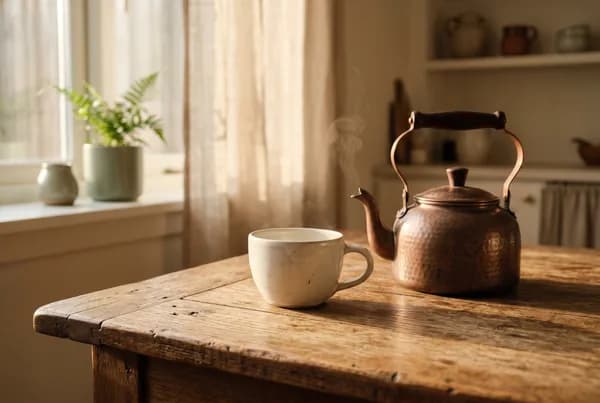
Everyday presence is the quiet act of being fully where you already are - at the sink, on the stairs, mid-sentence - without reaching for the next thing. It asks nothing dramatic. It only asks that you stop skimming the surface of your own life and let one plain moment hold you.
I used to think presence lived somewhere special. On a clifftop, maybe. In a long silence I'd earned.
Then I noticed it waiting in the kitchen.
What everyday presence actually means
Everyday presence means giving your full attention to the small, unremarkable thing in front of you - and discovering it was never small.
It is not a state you achieve. It is a place you return to, again and again, with the same ordinary effort it takes to look up.
I find it most often in the in-between. The kettle warming. The walk from the car to the door. The seconds before I speak. These used to feel like nothing, like dead time to be filled. Now I understand they were the day itself, and I kept missing them.
For a long time I waited for life to begin in the big rooms - the milestone, the trip, the conversation I'd been rehearsing. Meanwhile the small rooms filled and emptied without me. The folding of laundry. The cooling of tea. A whole quiet life, lived just out of frame.
There is a quieter way to live inside a normal afternoon. You don't have to escape it to feel it.
Why the ordinary slips past us
The ordinary slips past us because we have trained ourselves to look ahead. We finish the meal already planning the next one. We listen while drafting our reply.
I do this. I catch myself halfway out of a moment, leaning toward whatever comes next, and the present folds shut behind me like a door I didn't mean to close.
The mind treats the familiar as already known. It files the morning under seen this and stops looking.
But you have never lived this exact morning. The light has never fallen quite this way across the table. The person across from you has never been precisely who they are today.
When I remember that, something softens. The repetition stops feeling like a trap and starts feeling like an offering - the same plain gift, handed over once more.
There is also the simple speed of things. We move through the familiar quickly because we think we already have it. But speed and attention rarely travel together. The faster I go, the thinner the moment becomes, until the whole afternoon is a blur I can't quite recall by evening.
Slowing down, even a little, is how I let the ordinary back in. Not slow as a discipline. Slow as a kind of courtesy to my own life.
A practice for the unremarkable hour
To return to presence, choose one ordinary action and do only that, slowly, with nothing else running underneath.
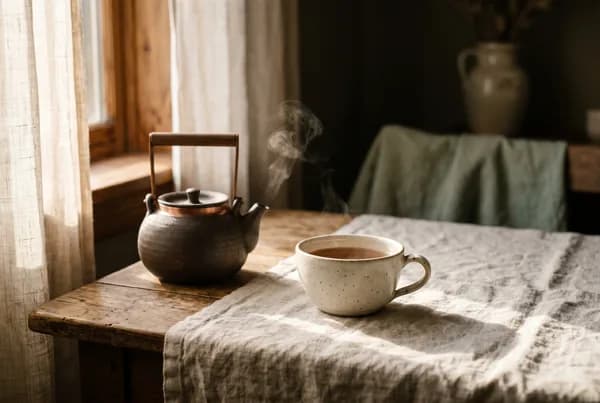
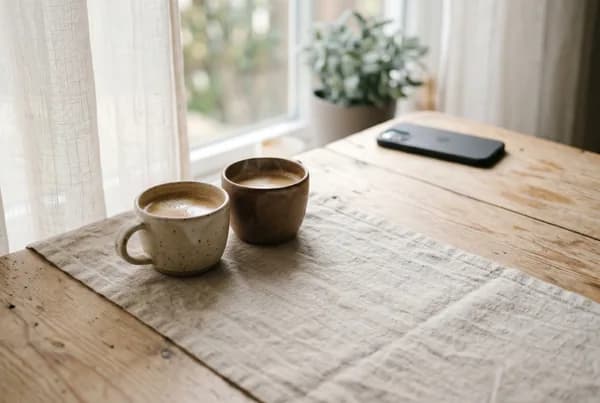
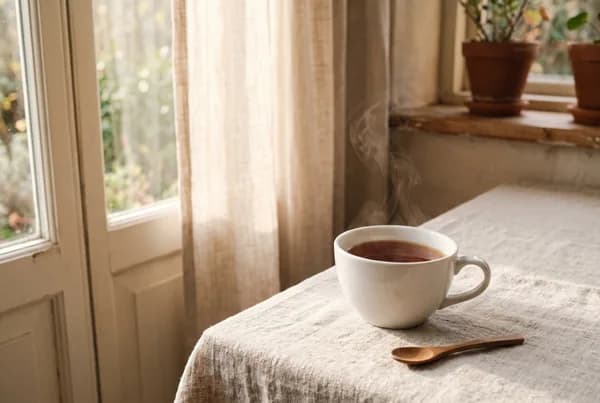
Washing a single cup is enough. Feel the warmth of the water. Notice the weight of the cup as it empties of soap. Let the task be the whole of you for one minute.
I keep mine small on purpose. A grand practice asks for a mood I rarely have. A small one asks for nothing but a cup.
You will drift. Of course you will. The point is not to stay - it is to notice you've gone, and come back, gently, the way you'd guide a wandering child by the shoulder.
This is the entire skill, if it is a skill at all. Leaving and returning. The returning is where presence actually lives.
If you want a steadier way to build this into the rhythm of a day, daily-high-vibe holds a few of these returns in one place - not a system, just small invitations to come back.
When presence feels like too much
Sometimes presence feels like too much because the moment you're in is hard, and you've been using motion to outrun it.
I know that flinch. The reaching for the phone, the tidying that isn't really tidying. The body looking for somewhere else to be.
You don't have to force yourself into a painful present. Presence is not endurance. On those days, being with the hardness for one breath - just one - is plenty.
I have sat at the edge of a difficult feeling and simply named it. This is grief. This is the tiredness. No fixing. Just company.
And the strange thing is, the moment rarely asks for more than that. It wants to be met, not solved. When I stop running, the ordinary stops feeling like something to survive and becomes, again, a place I'm allowed to rest.
To go deeper into how stillness threads through a whole day, you might follow the thread up to presence.
Coming back to where you are
Everyday presence is not a higher state reserved for the calm or the unhurried. It is available in the next plain moment, and the one after that.
I won't tell you to seize the day. The day is not something to seize.
It is something to notice. The cup. The light. The breath you're taking now.
Stay here a moment longer than you meant to.
That is the whole of it.