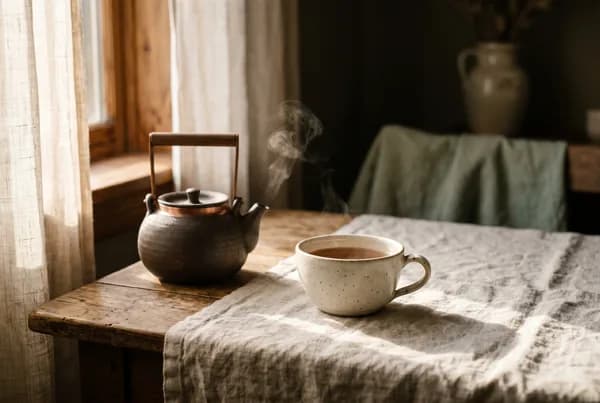
Single-tasking means giving one thing your whole attention until it is done, rather than splitting yourself across many. You close the other tabs. You let the email wait. You do the dishes, and only the dishes.
I used to think I was good at doing several things at once. I was good at feeling busy. That is a different thing.
The morning I noticed it, I was making tea while answering a message while half-listening to the radio. The tea went cold. The message read wrong. And I could not have told you a single word the radio said.
Why doing one thing feels so hard now
It feels hard because we have trained ourselves to expect interruption. The mind reaches for the next thing before the first is finished, and that reaching has become a habit deeper than any task.
I felt this most in small moments. Waiting for the kettle, I would pick up my phone. Standing in a queue, I would check something. The gap had become unbearable, and I had stopped noticing the gaps were where I used to breathe.
So the difficulty is not really about focus. It is about tolerating a single thing, with nothing else underneath it.
That tolerance can be rebuilt. Slowly. Without force.
What single-tasking actually feels like
Single-tasking feels, at first, like boredom. Then it feels like relief. You are doing one thing, and the one thing is enough, and there is a strange spaciousness in that.
I remember the first time I let it happen on purpose. I was folding washing. I decided to only fold. No podcast, no plan for later, no list running in my head.
The first few minutes were loud inside. My mind kept offering me other things to think about, like a child tugging a sleeve.
Then it settled.
The warm cotton. The square corners. The small pile growing. It was such an ordinary thing, and I felt more myself doing it than I had all week.
That is the quiet gift of one thing at a time. You come back into the room you are standing in.
How to begin, gently
Begin with something you already do every day, and choose to do only that. Not the hard tasks. Not the work that matters most. Something small enough that nothing is lost if your mind wanders and you bring it back.
I started with my morning coffee. For the length of one cup, I would do nothing else. I would not reach for my phone or rehearse the day. I would drink the coffee and watch the light come up.
It was harder than it sounds and simpler than I feared.
Here is the practice, if you want it. Choose one daily thing. Before you start, take a single slow breath and say to yourself, quietly, this is the only thing now. When your attention drifts, and it will, do not scold it. Just return. The returning is the practice, not the staying.
Some days I returned a hundred times in a single cup of coffee. That is fine. The count does not matter. What matters is that each return was a small act of choosing the moment I was actually in, over the dozen imagined moments pulling at me.
You will not get it perfect. Perfect is not the point. The point is that you noticed you left, and you came back.
A small daily ritual can hold this kind of attention beautifully - there is more on that in the ritual hub, if it draws you. And if you want a gentle frame for the whole day, Daily High Vibe was made for mornings like the coffee one.
When the one thing is hard or dull
Single-tasking is most needed exactly when the thing is dull. The boring task is where the mind most wants to escape, and so it is the truest place to practise staying.
I notice this with the work I would rather avoid. Paying bills. Tidying the cupboard I have been ignoring. My instinct is to make it bearable by doing three other things alongside it, but that only thins the whole afternoon into something I cannot feel.
When I let the dull thing be the only thing, something softens. It is still dull. But it ends. And I am present for its ending, instead of having spent the time somewhere else entirely.
I have come to think the dullness was never the enemy. The enemy was the splitting. A boring task done wholly is still rest of a kind, because the mind is allowed to stop bracing for the next thing. A boring task done while three other things flicker at the edges is just a quiet exhaustion I do not notice until later.
There is a quieter way to move through a day. It is not faster. It does not promise more. It only offers you the thing in front of you, whole, and yourself, whole, meeting it.
That is enough. More than I knew to ask for.
So I keep coming back to one thing. The tea, while it is still warm. The page, while I am still reading it. The person in front of me, while they are still speaking.
One thing. Fully. And then the next.