
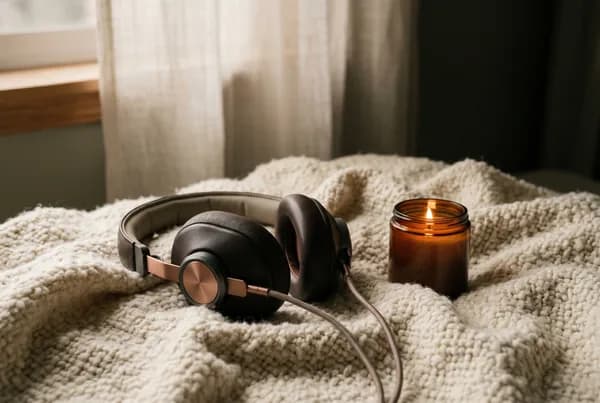
A guided sleep meditation is a recorded voice that leads you gently toward rest, usually through slow breathing, body awareness, and calm imagery. The best ones ask little of you and let you drift off mid-way. What to look for is a guide that helps you disappear, not one that holds your attention.
I have listened to a great many of these over the years. Some left me more wired than before. A few felt like being lowered into warm water.
The difference was rarely the production.
It was the intention behind the voice.
What makes a good guided sleep meditation?
A good guided sleep meditation is unhurried, undemanding, and content to lose you halfway through. It uses a slow, low voice, long silences, and no payoff at the end. The point is for you to fall asleep before it finishes. A guide that needs you awake to hear the ending is the wrong kind.
The first thing I listen for is pace.
Many recordings move too quickly. The voice gives instruction after instruction, never quite leaving a gap, and you find yourself keeping up rather than letting go. That is wakefulness dressed as relaxation.
The good ones are full of silence.
They say a little, then leave you alone with it. The pauses are where the actual resting happens. A guide who trusts the silence trusts you, and that trust is itself relaxing.
I also notice whether the meditation has somewhere to arrive. A wind-down with a clever ending, a lesson, a neat conclusion, is secretly asking you to stay conscious for it. The best sleep guides go nowhere on purpose. They simply thin out and fade, happy to be talking to a sleeping person.
If it would not matter that you missed the last five minutes, it was made by someone who understands sleep.
What kind of voice helps you fall asleep?
The voice that helps you fall asleep is low, slow, warm, and a little flat, without the rise and fall of someone trying to hold an audience. It should feel like company, not performance. A voice with nothing to prove lets your guard down.
Voice is intimate. You let it into your ear in the dark, when you are most undefended.
So it matters enormously how it carries itself.
A performing voice, bright and expressive and slightly selling something, keeps me alert without my meaning to. Part of me stays up to receive the performance. I cannot drift while someone is presenting to me.
The voices that work have given up on impressing me. They are low and even, almost monotone, warm without working at it. They sound like a person sitting quietly beside you who does not mind if you fall asleep mid-sentence. In fact, they would prefer it.
There is a generosity in that flatness. The voice is not asking to be admired. It is just keeping you gentle company until you no longer need it.
That is the quality I look for now. Not beauty. Kindness with the volume turned down.
If this way of meeting rest appeals to you, the wider field of sleep is built on the same patience, the same refusal to hurry you anywhere.
How long should a guided sleep meditation be?
A guided sleep meditation should be long enough that you fall asleep before it ends, which usually means longer than you think. Twenty to forty minutes of slow, fading guidance gives sleep room to arrive on its own schedule. A short, brisk track ends before your body has loosened.
Length is often misunderstood.
People reach for short meditations, imagining efficiency. But a brisk ten-minute track tends to finish while you are still settling, and then the silence afterward feels like a small abandonment.
What you want is a long, gentle slope.
A recording that keeps you loosely company for a good while, fading and thinning as it goes, so that whenever sleep finds you, the guide is still softly there. You are never asked to land at a particular minute. You simply slip away somewhere along the line, and the meditation does not mind where.
The best length is the one you never reach the end of.
A way to use it
The way to use a guided sleep meditation is to treat it as company rather than instruction, following loosely and letting yourself drift off without finishing. Press play, settle in, and give yourself full permission to fall asleep mid-way. Nothing is missed by leaving early.
Here is how I would suggest beginning.
Choose something slow and long, with a voice that does not try too hard. Lie down as you would to sleep. Start it at a low volume, low enough that you have to soften to hear it.
Then follow it loosely, the way you would half-listen to a friend talking in the next room. You do not need to catch every word. You do not need to do the instructions perfectly. Let the voice be a thread you hold lightly, ready to drop the moment sleep tugs you under.
And when you wake and realise you never heard the end, count that as success. You were not meant to.
If you would like a place to start, deep rest was made in exactly this spirit, slow and undemanding and content to lose you partway, with a free way in.
The right guided meditation does not deliver you to sleep like a parcel.
It simply walks beside you toward the dark, talking softly, until you have wandered off on your own and it can quietly stop.
That is all a good voice is for.