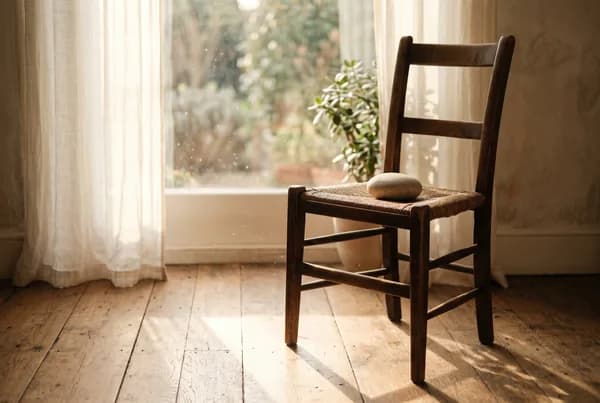

Stillness feels uncomfortable because the noise you carry has nowhere to land when you stop moving. The restlessness, the half-finished thoughts, the low hum of unease - they were always there. Activity just kept them out of focus. Sitting still doesn't create the discomfort. It reveals it.
I learned this the slow way.
For a long time I thought I was bad at being calm. I would sit down to rest and feel something tighten in my chest. A pull to get up, to check, to fix, to fill the gap. I read that as proof that quiet wasn't for me. Some people are still. I was not.
That was the wrong conclusion.
Why does stillness make me feel anxious?
Stillness can feel anxious because it removes the distractions you've been using to outrun an inner state - so the moment you stop, that state becomes audible. The body reads the absence of input as exposure. Nothing is happening, so something must be wrong.
I notice this most in the first two minutes.
I sit, and almost at once a small panic arrives. It rarely has a clear shape. It is more like static. A sense that I should be doing something, that resting is a kind of falling behind. My hands want a task. My mind starts drafting lists.
For years I obeyed that signal. I would stand up and find a chore, and the relief was real.
But the relief never lasted, because I hadn't met anything. I had only postponed it.
What changed was small. I stopped treating the discomfort as a verdict and started treating it as information. The static wasn't telling me to leave. It was telling me what had been waiting under the motion.
What does it mean when sitting still feels wrong?
When sitting still feels wrong, it usually means your nervous system has learned to associate safety with motion. You feel calm while busy not because busyness is restful, but because it gives the unease a job. Take the job away, and the unease has only you to talk to.
I think this is more common than we admit.
We praise people who never stop. We call it drive. And somewhere along the way, a lot of us came to believe that stopping is unsafe, that the still moment is where the difficult feeling will finally catch up.
So we keep ahead of it. We answer one more message. We tidy one more shelf.
The strange mercy is that the feeling we're fleeing is almost never as large as the running suggests. When I finally sat with mine, it was mostly tiredness. Grief I hadn't named. A worry I'd been carrying sideways for weeks because I never gave it a clear minute.
It was uncomfortable. It was not unbearable.
That gap - between what we fear stillness contains and what it actually holds - is where a quieter life begins. You can read more about meeting that edge on the stillness pillar.
How long does the discomfort last?
The acute discomfort of sitting still usually softens within a few minutes, once the body registers that no real threat is present. It does not vanish. It settles. The sharp edge of "I must get up" loosens into something more like a held breath finally let go.
I want to be honest about the timing, because the early seconds are the hardest.
If you leave in the first minute, you only ever meet the alarm. You never meet what comes after the alarm, which is usually a kind of softening you can't reach any other way.
So I started staying a little longer. Not to win. Just to see.
Here is the gentle practice I return to. Sit somewhere you can lean back. Let your hands rest open, palms up, in your lap. When the urge to move arrives - and it will - name it quietly to yourself. There it is. Then stay for three more slow breaths. Only three. You are not signing up for an hour. You are giving the alarm a moment to finish speaking.
Most times, by the third breath, the pull has eased.
Not because you fought it. Because you let it be there without obeying it.
If you'd like a small daily container for this, the Daily High Vibe practice offers one short moment of stillness each morning - a place to meet the static before the day fills up. It asks very little. That's the point.
Is the discomfort a sign I'm doing it wrong?
The discomfort is not a sign you're doing it wrong. It is usually a sign you've stopped long enough for something true to surface. The unease is the work, not the failure of the work. A still mind that felt only pleasant would have nothing to teach you.
This took me years to believe.
I kept waiting for stillness to feel good, and judging myself when it didn't. But the goal was never a pleasant blankness. The goal was to be present for whatever was already here, including the parts that fidget and ache.
When I let go of needing it to feel nice, it got easier.
I stopped sitting down to escape my mind and started sitting down to keep my mind company. Those are different acts. The first is a fight. The second is a kind of friendship.
The discomfort still visits. I no longer read it as a closed door.
It is just the sound a busy life makes as it slows.
And underneath it, every time, there is somewhere quieter to stand.