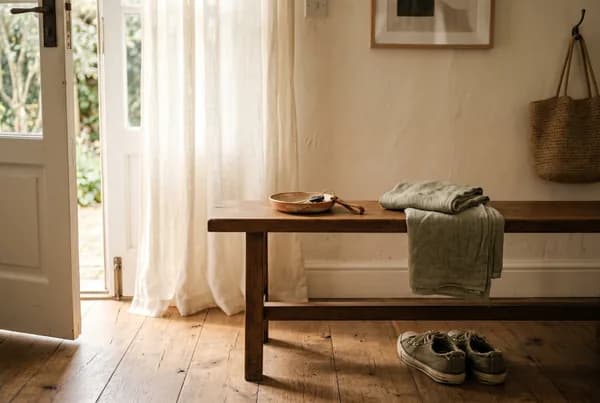
I walk through the front door most evenings with my keys still in my hand and my mind still in the car, replaying a sentence I didn't quite say to someone three hours ago. The hallway light is on. The kettle is where it always is. And I am, technically, home. But it takes me another forty minutes to actually get here - to notice that I'm standing in my own kitchen, that the day is over, that I can put the keys down.
I used to think arriving was a thing that happened to the body. You go somewhere, and then you are there. Simple as crossing a line on a map.
It isn't that simple, and I suspect you already know it isn't.
There's a particular gap I've started to notice - the gap between being somewhere and being in it. You sit down to dinner, and your fork is moving, and your face is pointed at the people you love, but some essential part of you is still in the meeting that ran late. You walk into a friend's house and you're warm and you're saying the right things, but you haven't fully crossed the threshold yet; the last room you were in is still around you like a coat you forgot to take off. You can spend a whole evening somewhere and never quite turn up.
I think this is one of the quietest losses there is. Not dramatic. Just a slow leak. We are forever an hour behind ourselves, living each place only after we've already half-left it.
The thing that made me see it was a doorway. My own back door, specifically, the one between the garden and the kitchen. One afternoon I'd been out repotting something, hands full of soil, and I came inside and went straight to the sink, and as I was rinsing my hands I realised I had no memory of the door at all. I'd passed through it the way you pass through a hundred doors a day - as a non-event, a gap in the wall, a thing that simply lets you keep going. I'd been outside, and now I was inside, and the moment of becoming-inside had happened to no one. I'd missed my own arrival.
After that I couldn't stop seeing it. The crossings I made without being present for any of them. Stepping out of the car. Sitting down at my desk. Walking into a room where someone was waiting for me. Each of these is a small threshold, a place where one part of life ends and another begins, and I was sleeping through every single one - carrying the momentum of the last thing straight into the next, so that nothing ever got a clean edge.
What I found - and I offer this gently, because it's small and it took me a while to trust it - is that arriving has very little to do with where your body is. It happens at the threshold, or it doesn't happen at all. The doorway is not a gap to be hurried through. It's the hinge of the whole thing. If I can be there for the crossing - just for the second or two of it - I tend to land in the room. If I miss the crossing, I spend the next half hour somewhere else, wearing the last room like that coat.
It surprised me how physical it is. Arriving isn't a thought you have. It's something closer to letting your weight down. There's a moment when I sit at my desk where I either drop into the chair as a person who has come to do this work, or I land in it still mid-stride from whatever came before, already leaning toward the next thing. The chair is the same chair. The difference is entirely in whether I showed up for sitting down.
So here is the small thing I've been practising, and I share it only as something to try, not something you should do.
When you cross a threshold - any threshold, the front door, the door of the room your child is in, the line between standing and sitting - let the crossing take a single breath. Not a held breath, not a special one. Just notice the doorway as you pass through it, the way you might notice a step you don't want to trip on. You are leaving one place. You are entering another. Let there be a seam between them. Breathe once on the seam, and then walk in as someone who has actually arrived, rather than someone still finishing the last room.
That's the whole of it. One breath at the door.
I won't pretend I do it every time. Most evenings I'm still halfway up the hall before I remember. But the times I catch the threshold - the times I let the back door be a door again, let sitting down be an arrival - I find I'm where I am much sooner. The keys go down. The day actually ends. I'm home an hour earlier than I used to be, not because I drove faster, but because I bothered to walk in.
There's something almost tender about it, I think. The places we move through are patient. The kitchen waits. The chair waits. The person across the table has been hoping, quietly, that we'll turn up. All of it is just standing there on the other side of a doorway we keep rushing past, asking nothing of us except that we arrive - that we let ourselves be, for one breath, in the act of coming in.
You are already going to walk through a door today. Perhaps a dozen of them. Maybe one of those can be the place you finally land.